Everything you need to know about a powerful social media strategy for entrepreneurs

Many entrepreneurs post whenever they happen to think about it: a photo of a handmade product, a quick promo… It feels like you’re doing well on social media, but without a plan you don’t know what all that effort is actually worth. And let’s be honest: likes still don’t pay the bills. That’s why you need a clear social media strategy. It’s an essential part of successful online marketing.
TL;DR
With this article, you’ll set up a simple but powerful social media marketing strategy in 60 minutes. You choose clear goals, one or two channels, and a realistic content plan. With a tool like Metricool, you can plan and analyse everything, so social media finally delivers results instead of only costing you time. Analysis is essential to assess content performance and continuously optimise your strategy.
- What is a social media (marketing) strategy?
- Why is a social media marketing strategy important for you?
- Social media strategy: step-by-step plan
- Step 1: define your social media goals
- Step 2: choose the right social media channels
- Step 3: build a realistic social media content strategy
- Step 4: get more out of your strategy with social listening and social selling
- Step 5: your social media strategy in 60 minutes
- Example: a social media strategy for an SME
- Tools and support: how to stick to your social media strategy
- Practical tips for a sustainable social media approach
- How do you use Metricool for your social media strategy?
- Start today with a realistic social media approach
- Frequently asked questions about a powerful social media strategy for entrepreneurs
In this article, we show you how to work out a social media marketing strategy in about an hour. We take you through the steps, give a concrete example of a business like yours, and show how a tool like Metricool helps you stick to your plan.
At Combell, you won’t find recycled theory. Instead, you’ll get a simple, effective step-by-step plan tailored to SMEs and self-employed professionals: knowing why you post, who you want to reach, and how to measure whether it’s working. 😉
What is a social media (marketing) strategy?
A social media strategy is a plan that describes why you’re active on social media, who you’re posting for, what message you’re sharing, and how you’ll measure success. So it’s much more than ‘posting something on Facebook or Instagram every now and then’.
A social media strategy helps you work in a structured, goal-driven way - just like a business plan does for a company. Without such a plan, your chances of success are significantly lower.
Without a strategy, you get ‘random posts’: a promo here, a photo there, sometimes weeks of nothing. In other words: scattered shots in the dark.

With a social media strategy plan, you create consistency in your communication. Your posts align better with your business goals, and you know what results to expect.
Social media should never stand apart from the rest of your marketing. Your strategy connects to:
- your website or webshop
- your email marketing (e.g. Flexmail via Combell: 6 months free + 15% discount on a paid subscription)
- your offline actions (events, flyers, local campaigns)
Social media only really works when you know why you’re posting and what you want to achieve. Otherwise, it’s just aimless online chatter.
Isabel Romero, Head of Marketing at Metricool
In short: a strong strategy is essential if you want to use social media effectively for growth, brand awareness, and customer relationships.
A social media strategy makes the difference between random posts and a structured approach that helps you reach your goals. It helps you switch to targeted actions that actually deliver.
Why is a social media marketing strategy important for you?
Nobody has time! For many Belgian SMEs, finding time is the biggest challenge. You may not have a big marketing team yet — and as a small business owner, you’re often responsible for social media yourself.
Sometimes you feel like that meme of a completely overworked cat furiously hammering a keyboard. 😁 That’s exactly why a smart social media strategy for entrepreneurs matters.
A good strategy gives you:
- More consistency and recognisability
You show up regularly in your target audience’s feed with recognisable posts and actions. That strengthens your brand. A social media strategy also helps increase both brand awareness and name recognition, because your business is visible more consistently.
- Focus on what truly works
You choose channels and formats intentionally, based on your goals. No more feeling like you have to be everywhere. Instead you build a focused social media strategy plan.
- More efficient use of time and resources
With a clear plan, you can prepare posts and schedule them ahead of time. You reduce stress and improve results.
- Measurable results
Because you define your goals upfront, you can check afterwards whether you’re on track. With effective social media activity, you can see whether your strategy is paying off and contributing to a positive return on investment (ROI).
Without a strategy, social media often feels like “ugh, another task”. With a simple social media strategy, it becomes a logical part of your day-to-day operations.
A strong brand story on social media is essential too: it defines the tone, emotion and formats of your content, and helps you build a stronger bond with your audience.
Social media strategy: step-by-step plan
Step 1: define your social media goals
Want to build a social media strategy? Remember: a good social media marketing strategy always starts with clear goals. Ask yourself: what do I want social media to deliver for my business?
Examples of goals:
Keep your goals concrete and measurable. You don’t need complex models. Think in followers, clicks, comments, completed forms, or enquiries.
Before you start, do a baseline measurement. This helps you understand what content performs well today and where improvements are possible. Then monitor and optimise based on conversions and engagement - not likes.
That way, you’ll know whether your social media marketing strategy really contributes to your business goals.
Also connect your goals to other channels:
- Social media → website (blog, landing page, webshop)
- Social media → email marketing (newsletter sign-ups via Flexmail)
This turns your social media marketing strategy into a natural extension of your over all marketing.
Step 2: choose the right social media channels
A common mistake: shouting into the void on every platform just to “be present”. Facebook, Instagram, LinkedIn, TikTok, Pinterest… Honestly? That’s almost impossible for an SME.
So building a strong social media strategy starts with making (and daring to make) choices:
Where is your audience?
Is your audience mainly B2B and do you offer professional services? Then a strategy focused on LinkedIn is usually more interesting.
Do you focus on everyday consumers (B2C) and want to stand out visually? Then an Instagram-focused strategy often makes more sense.
Choosing the right channel also depends heavily on demographic data such as age, gender and location. By analysing these, you can determine which channel best fits your audience and communication strategy. Choosing the right channels is essential to reach your target audience effectively.
What content can you realistically create?
Do you easily take photos and short videos? Then Instagram or TikTok are a good match. Not your thing? Experiment with tools like Canva or get help (for example via AI).
Do you work a lot with expertise and case studies? Then LinkedIn is usually the better pick. On this platform, clear and informative posts can still perform really well.
How much time do you have?
It’s better to pick 1-2 main channels and do them well than to be half-present everywhere. Don’t do the YOLO approach. 😊
It also helps to understand how each platform’s algorithms work. The better you understand them, the better you can optimise your content strategy and maximise reach.
Your social media strategy doesn’t need to be complex. The power is in focused choices and consistency.
Social media strategy example: making choices
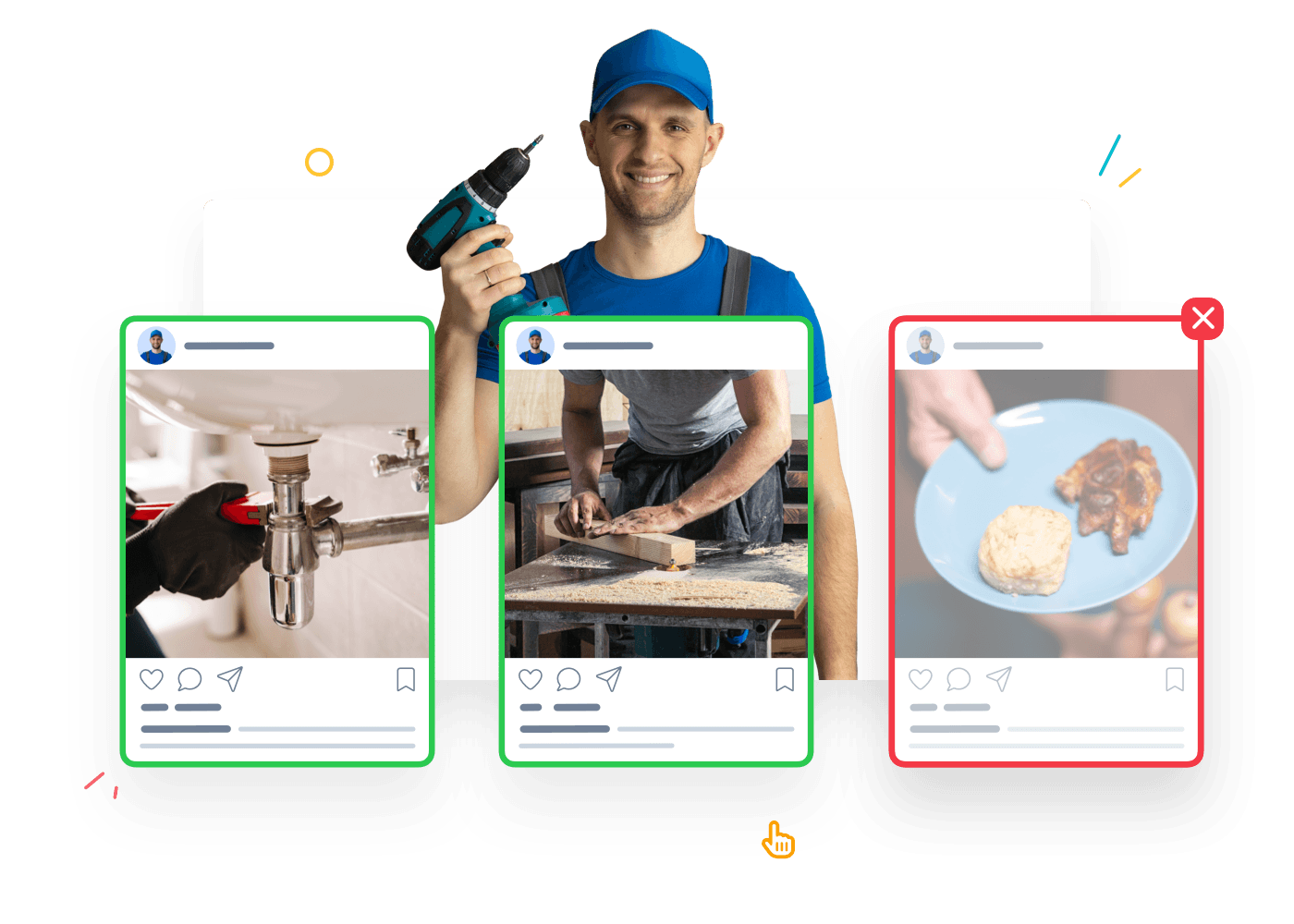
A local contractor with a small team chooses Facebook and Instagram, sharing job-site photos and before-and-after shots. A software company selling to SMEs focuses on LinkedIn with case studies, tips and webinars.
Step 3: build a realistic social media content strategy
Now that you know your goals and channels, it’s time for your social media content strategy. This answers the question: what are you going to post?
Busy entrepreneurs and SMEs can work with content categories. Choosing the right content type is key: different types, such as educational, inspirational, promotional, each support specific goals such as visibility, authority or sales.
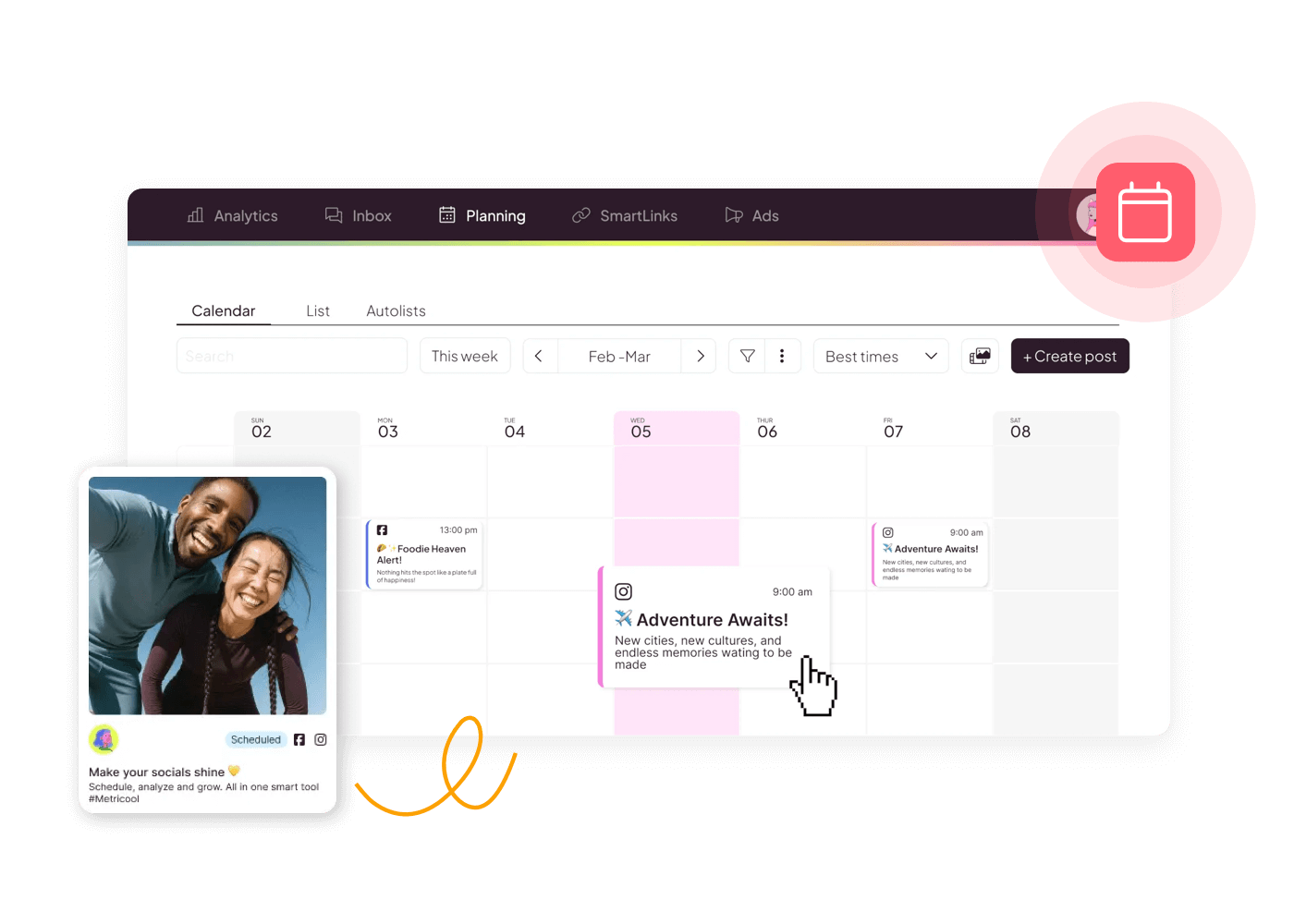
Types of content:
A good rule of thumb is the 80/20 rule: 80% of your content is informative or inspiring, and max. 20% is promotional.
The rest should help your followers move forward with tips & tricks, inspiration, or stories. Strong images and videos are crucial for effective content: they stand out more in your audience’s feed.
Tip
Use a content calendar. It structures production and distribution, prevents gaps, and helps you work more efficiently throughout the year. Regularly analyse which content is missing and what you need to create for future campaigns.
Example of a simple content plan
Let’s say you’re a freelance consultant mainly active on LinkedIn and Instagram. Your week could look like this:
You can also work with fixed formats, such as:
A simple but effective schedule like this makes your social media strategy recognisable and easier to stick to.
Planning, executing and monitoring your social media activities is the foundation of an effective social media marketing strategy.
By deciding up front which activities you’ll focus on, you can work towards goals like brand awareness, engagement and conversions — and make sure your effort supports your business.
Step 4: get more out of your strategy with social listening and social selling
A good social media strategy doesn’t stop at posting valuable content or building an Insta-perfect profile. If you really want to get the most out of your channels, social listening and social selling are essential parts of your approach.
Social listening means actively listening to what’s being said on social media about your brand, products or services. It goes beyond replying to DMs or tags.
With social listening, you discover what your audience cares about, which needs and questions they have, and where your brand is being mentioned - positively and negatively. That allows you to respond quickly to negative feedback, solve issues before they escalate, and gather valuable insights for new content or product improvements.
Practical example with Combell as the main character
We offer managed hosting and cloud solutions. Imagine we notice multiple customers asking questions about GDPR compliance on LinkedIn or X. By responding quickly and transparently, you show expertise and build trust. Social listening helps you continuously improve your social media strategy and strengthen your brand.
Social selling is the final stage of a strong social media strategy. Here, you use social media to build business connections, generate leads and, ultimately, sell your products or services.
This works especially well on LinkedIn, where you can connect with potential customers in a targeted way. But Instagram and Facebook can also support social selling through stories and organic content. Worth trying!
The secret to successful social selling? Don’t sell straight away. First provide value, build relationships, and respond to your audience’s needs.
Share customer cases, tips or inspiring stories that show how your solutions work in real life. Engagement grows, and the step towards requesting a quote or making a purchase becomes smaller.
By combining social listening and social selling, you turn your social media strategy into a powerful plan.
You understand what’s going on with your audience, respond to their interests and needs, and use your channels to bring in valuable leads at the right moment. That’s how social media becomes a key part of your marketing strategy and your sales process. 😉
Step 5: your social media strategy in 60 minutes
No joke: creating a social media strategy really doesn’t have to take days. With this short plan, you can build a solid base in one hour! Perfect to do so between client meetings or while the coffee is brewing. Grab a cookie.
Tip
Use Social.Coach as your personal sparring partner on social media. It gives you concrete suggestions for better posts, timing and content, so you no longer have to guess but can grow step by step. Included in all Metricool packages!
1️⃣ Write down your goals (10 minutes)
Choose 1 to 3 goals for the next 3 to 6 months.
2️⃣ Choose your main channels (10 minutes)
Limit yourself to 1 or 2 platforms where your audience definitely is.
3️⃣ Brainstorm 10-15 content ideas (15 minutes)
Think of customer questions (user-generated content), common problems, and FAQs you get via email or phone.
4️⃣ Decide on a basic frequency (10 minutes)
For example: 3 posts per week on your main channels.
5️⃣ Schedule your posts with a tool (15 minutes)
Use a scheduling tool like Metricool to place your ideas into a calendar. That way, your strategy plan is neatly scheduled - and you no longer have to “quickly post something” every day.
Tip
Make sure the technical basics of your social media marketing strategy are in place. Tools like Google Tag Manager help you manage tracking codes and pixels efficiently. Also do a baseline measurement to understand which content is performing well (or poorly) based on your KPIs. And regularly analyse competitors: look at their content strategy, interactions and customer responses to learn and improve your own approach. Most important: your strategy doesn’t have to be perfect. Better “good enough” and consistent than “ideal on paper” but never executed.
Example: a social media strategy for an SME
Let’s take a fictional example: ‘Mila’s Furniture Shop’, a small Belgian business that offers interior advice to customers who want to redecorate their home.
Mila’s Furniture Shop goals (3 months)
- 30% more website visitors via social media
- 50 new Instagram followers per month
- At least 10 quote requests via the contact form
Target audience
Private customers in Flanders who want to (re)decorate their home.
To understand her audience better, Mila uses personas: detailed profiles of her ideal customer, including demographics, interests and pain points.
Analysing that data and online behaviour is crucial to create relevant content that matches what her audience needs.
Chosen channels
- Instagram (strong visuals, perfect for interior photos)
- Facebook (local visibility and existing customers)
Content types
- Educational: “3 mistakes people make when choosing lighting”, “How do you define your interior style?”
- Inspirational: before-and-after photos, mood boards, stories from ongoing projects, inspiring stories…
- Promotional: limited-time offers, free intake session, promotion for a workshop
Important: Mila develops formats that match each platform’s features, so content and engagement perform optimally.
Simple weekly plan
- Monday: educational carousel post (tips)
- Wednesday: inspirational project spotlight
- Friday: promotional post linking to the contact form
Mila schedules her posts one month ahead. Then she uses a tool like Metricool to see which posts get the most reach, saves or clicks. Based on that, she adjusts her strategy step by step.
Her content strategy puts her brand story at the centre, so communication stays recognisable and engaging for her audience.
Tools and support: how to stick to your social media strategy
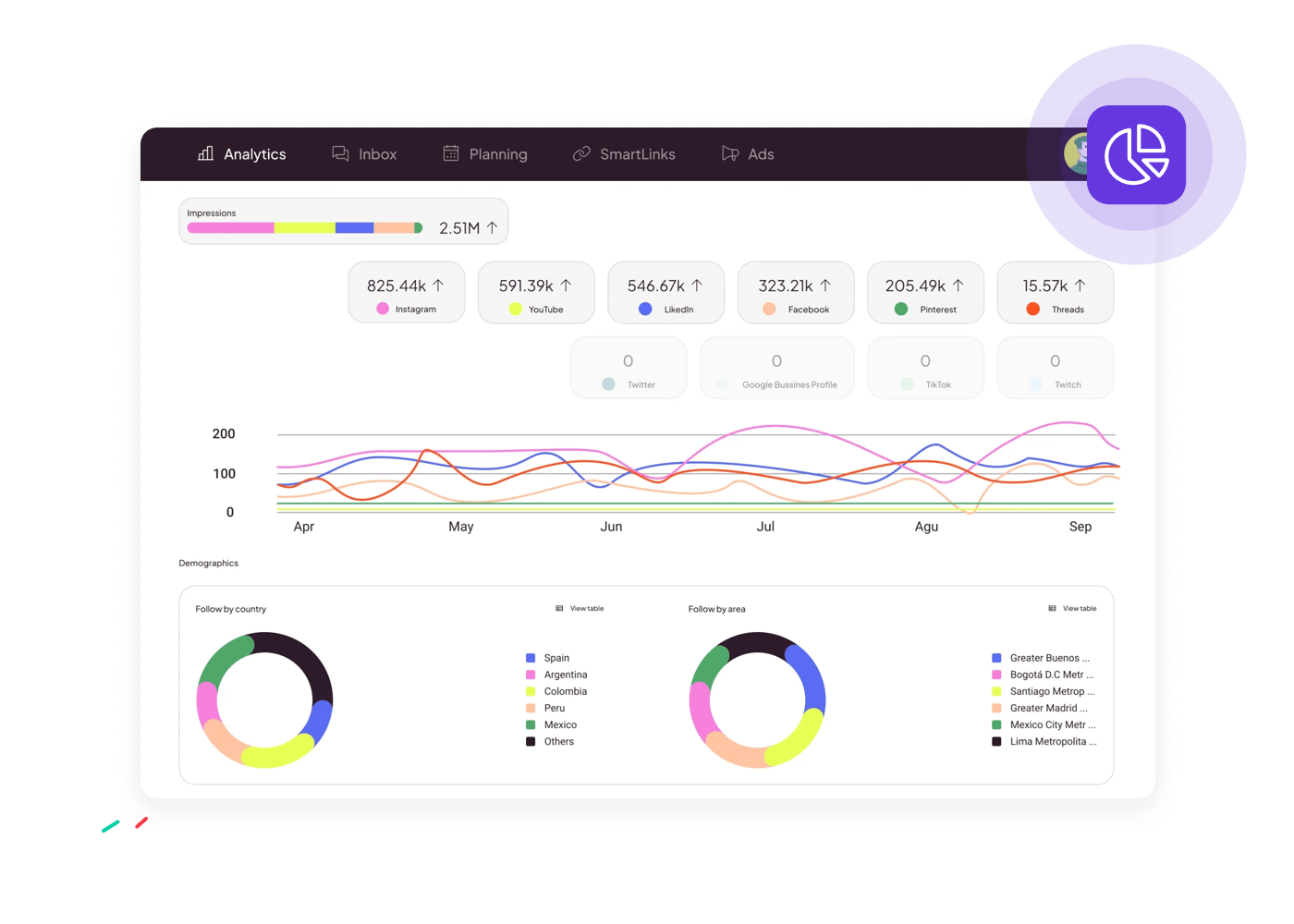
Coming up with a strategy is one thing, sticking to it is another. Without structure, you quickly fall back into “we’ll post when we remember”. Usually at the exact moment you actually want to go home.
Tip
Use the Social Coach as your personal sparring partner on social media.
It gives you concrete suggestions for better posts, timing and content, so you can stop guessing and grow step by step. Included in all Metricool!
But you’re a survivor! That’s why tools are essential if you want to keep your strategy going (and make it work)
- You can schedule posts in advance.
- You gain insight into stats and results.
- You see which content performs best.
- You can easily create reports for yourself or your team.
Anyone who takes social media seriously should look at the numbers at least once a month. Measuring and automating is the difference between hoping and knowing.
Isabel Romero, Head of Marketing at Metricool
With a tool like Metricool, you can manage all your channels in one place: plan, analyse and optimise. That makes your strategy less dependent on “in-the-moment inspiration” and more on a solid plan.
And don’t forget email marketing. With Flexmail, you can invite people who land on your website via social media to subscribe to a newsletter. This helps you build your own database and rely less on algorithms.
(First 6 months free, then 15% discount on a paid subscription)
Practical tips for a sustainable social media approach
Use these concrete tips to stick to your strategy as an entrepreneur:
- Start small, but be consistent. Better 2–3 fixed posts per week than two weeks of intense posting followed by silence.
- Work with fixed formats. You’ll spend less time thinking about what to post and create faster.
- Schedule a fixed content moment. For example: one hour every Monday morning. Use it to brainstorm and schedule all posts for the week.
- Measure monthly and adjust. Analyse your current audience: who your followers are, how they interact, and where you see growth or engagement. Use these insights to refine your strategy. Look at what performs well (reach, engagement, clicks), optimise and adjust. Do more of what works, stop what doesn’t, and keep experimenting.
- Use tools to save time. A scheduling tool like Metricool prevents last-minute stress and helps you work more efficiently.
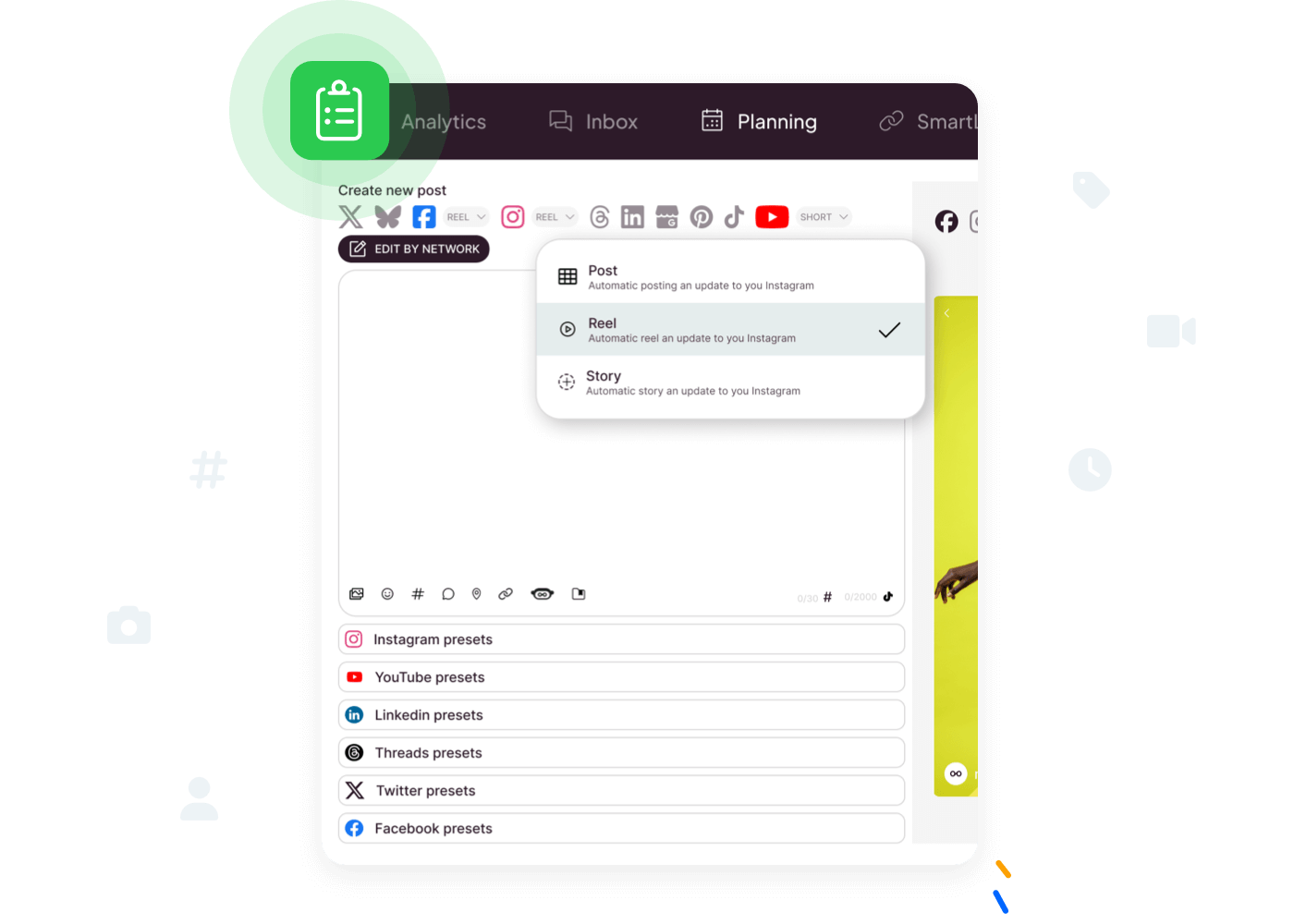
How do you use Metricool for your social media strategy?
In this article, we focused on the general principles of a strong social media marketing strategy. Now the question is: how do you make it practical and executable?
That’s where Metricool comes in.
Also read
With Metricool, entrepreneurs and SMEs can:
That’s how you turn “setting up your social media strategy” into a consistent habit without spending hours every day.
Tip
Start today with a realistic social media approach
A strong social media marketing strategy doesn’t have to be complicated. If you:
… then even as a self-employed professional or SME with limited time, you can make a big impact.
Without a strategy, social media stays a source of frustration and time loss. With a clear social media strategy for entrepreneurs and a tool like Metricool, your social media becomes a measurable engine for your business. Good luck!
Ask our experts for free advice
Frequently asked questions about a powerful social media strategy for entrepreneurs
Related posts